
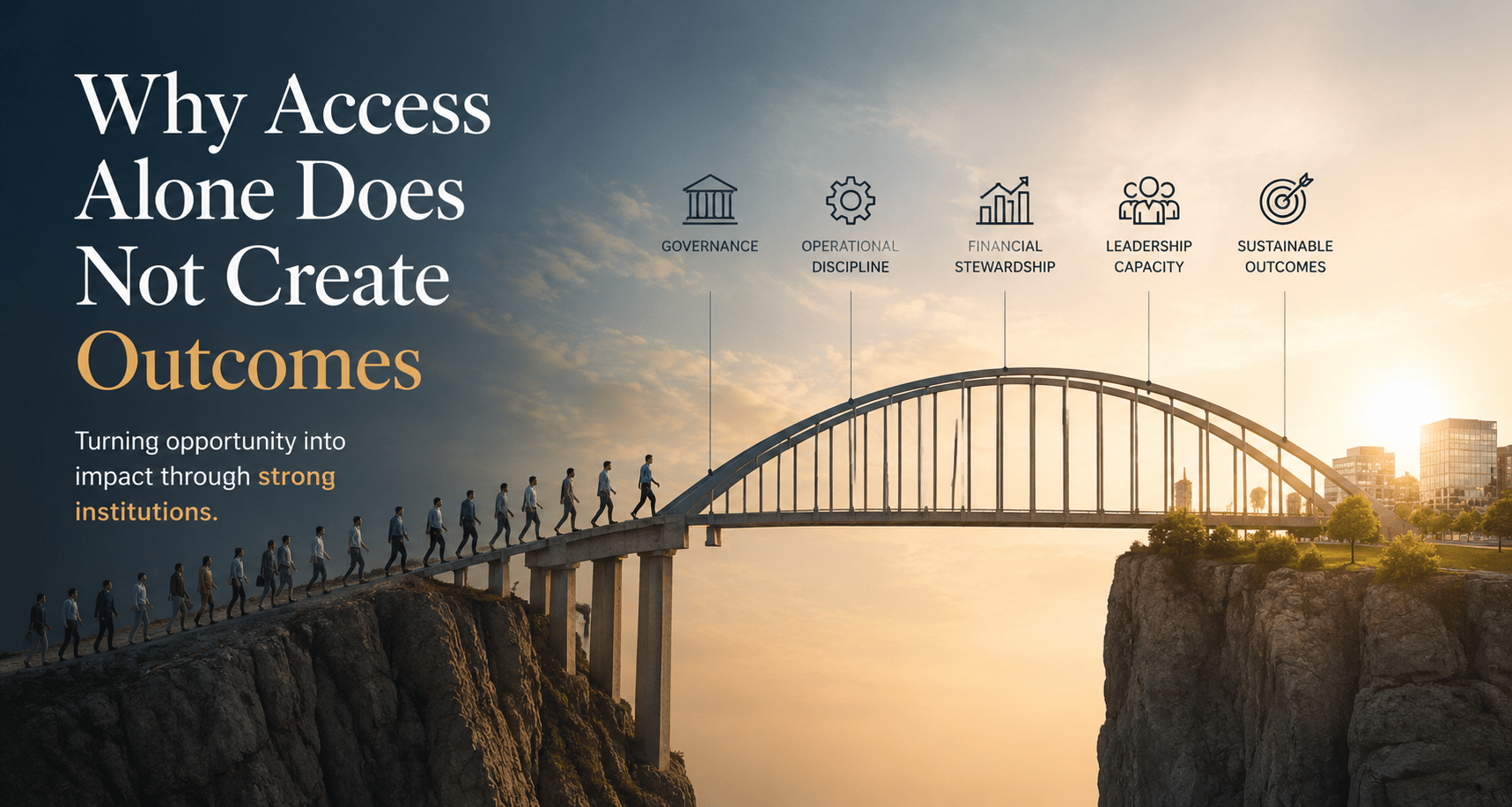
Every year, billions of dollars flow into education and public systems – including school districts, municipalities, and government agencies – through grants, public funding, private investment, technology initiatives, workforce programs, and philanthropic efforts. Yet despite unprecedented access to resources, many institutions continue to struggle to achieve sustainable outcomes.
Why?
The answer is both simple and uncomfortable: access alone does not create outcomes.
The Access Myth
Too often, leaders assume that funding, technology, or new opportunities will automatically translate into improved performance. In reality, resources are only inputs. Outcomes are produced by institutions.
An institution’s ability to convert opportunity into results depends on the strength of its underlying systems. Governance structures, financial discipline, operational processes, internal controls, and strategic leadership alignment determine whether resources are effectively deployed or quietly absorbed without meaningful impact.
Consider two institutions receiving the same grant. One possesses clear strategic priorities, strong accountability structures, disciplined financial management, and leadership alignment. The second struggles with unclear decision-making, inconsistent execution, and fragmented operations.
The funding may be identical. The outcomes will not be.
The Institutional Conversion Problem
This principle applies across the board, whether evaluating public charter networks, state agencies, or massive municipal systems. The institutions that consistently outperform their peers are rarely the ones with the most resources. They are the ones with the strongest systems.
At Guidato, we refer to this challenge as the institutional conversion problem — the gap between access and outcomes. Solving this gap requires leaders to focus not only on acquiring resources, but also on strengthening the institutional capacity required to deploy those resources effectively.
The Guidato Framework
Why Institutions Matter Most
The most successful leaders understand that sustainable growth is not merely a funding challenge. It is an institutional challenge.
Funding matters.
Technology matters.
Partnerships matter.
But institutions matter most.
Institutions that invest in strengthening governance, improving operational infrastructure, building financial discipline, and developing leadership capacity position themselves to transform opportunities into measurable and lasting results.
Access creates possibility.
Strong institutions create outcomes.